Four Guitars, one packed church

Updated: Dec 23, 2025
Vida Guitar Quartet light up a sold-out WiGS concert
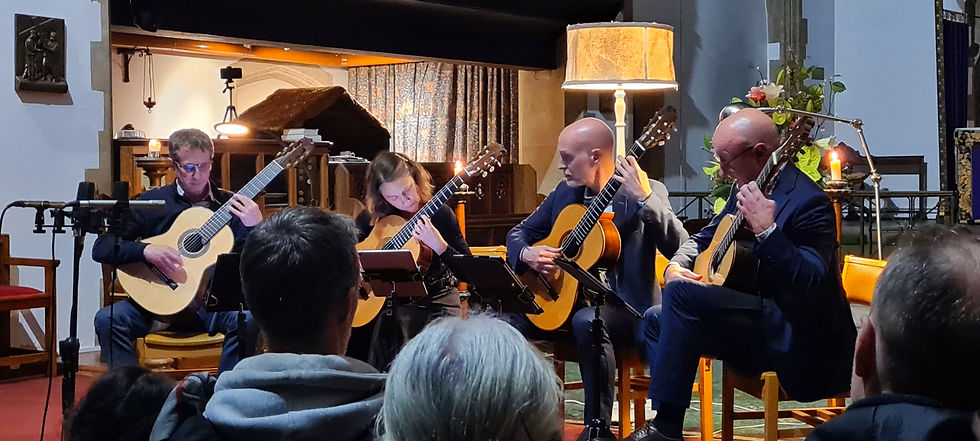
The people of WiGS waited with bated breath as the audience filed into St Saviour’s Church in Raynes Park. Vida Guitar Quartet had completely smashed through our seating capacity, making their 28th November performance our most popular professional concert to date. The atmosphere in the room reflected the occasion, with a real sense of anticipation for an evening that promised variety, colour, and musical personality.

WiGS Chair, Mark Nicholson welcomed the audience, and Vida Guitar Quartet confidently took to the stage with the rousing fortissimo octaves of Seventeen Come Sunday from Vaughan Williams’ English Folk Song Suite, an original arrangement by Mark Ashford.
This was soon followed by the heavily contrasting My Bonny Boy, which captured an unmistakable sense of English nostalgia, while Folk Songs from Somerset danced along with a light, cheerful swing.
Excerpt of ‘Folk Songs from Somerset’ from Vaughan Williams’ ‘English Folk Suite’ (arr. Ashford)
The suite proved to be a perfect, warm introduction to the evening, with ambitious yet cleverly arranged repertoire that spanned the full range of what four guitars are capable of producing.

Grieg’s Holberg Suite followed, arranged by Mark Eden. Originally written for piano and later adapted by Grieg himself for string orchestra, the work translated superbly to the guitar quartet. The opening Praeludium had real sparkle and drive, highlighting the ensemble’s extraordinary tightness and facility, with its relentless three-note ostinato underpinning a pristine melodic line.

Extract from ‘Holberg Suite for string orchestra, Op. 40’ by Grieg (Edition Peters, Leipzig)
The Sarabande and Air brought out the group’s refined sense of blend and phrasing. A particular highlight was the irresistibly catchy Gavotte–Musette–Gavotte, delivered with humour, rapid ornamentation, and the occasional cheeky ponticello to amuse the scattering of discerning guitarists in the audience. The Rigaudon was full of energy and good spirits, rounding off the suite in style.
Excerpt of ‘Gavotte-Musette-Gavotte’ from Grieg’s ‘Holberg Suite’ (arr. Eden)
It was in this work that the full range of the ensemble became most apparent: soaring upper voices contrasted against the solid foundation of Chris Stell’s seven-string Christopher Dean guitar. Small touches such as this allowed the arrangements to truly shine; without the extended range, some textures might have felt compressed or hollow. Instead, the result highlighted the ensemble’s rigour, imagination, and attention to detail.
Three of Brahms’ Hungarian Dances closed the first half, and these were great fun. The dramatic contrasts and rhythmic bite of Dances Nos. 1 and 3 came across vividly, but it was the final Fifth Dance that really brought the audience to life.
Hungarian Dance No. 5 is one of Brahms’ most instantly recognisable pieces, its jaunty, infectious tune familiar well beyond the concert hall. Many will recognise it from classic pop-culture moments, including the famous barbershop gag in Charlie Chaplin’s The Great Dictator or its use in the Looney Tunes short Pigs in a Polka.
Excerpt of ‘Hungarian Dance No. 5’ from Brahms’ ‘Hungarian Dances’ (arr. Stell)
Vida’s characterful, almost improvisatory performance had the audience erupting in whistles and bravos as the quartet left the stage. The first half was impressive, but little did we know what was in store for us after the interval.
On their return, the quartet were greeted warmly… though not before Chris Stell engaged in some relaxed crowd banter. Amid the laughter, mention was made of Vida’s upcoming release, Morphosis, featuring music by Grieg, Mozart, and Schubert. The album will be released on Deux-Elles Records this coming summer, and is well worth seeking out.
The second half opened with something completely different - Australian guitarist and composer, Phillip Houghton’s ‘Opals’. Superbly introduced by Amanda Cook, this piece takes inspiration from the dazzling colours and reflections of Australia’s opal gemstones.
Black Opal, Water Opal, and White Opal created a series of striking sound worlds, with Vida handling the shifting textures and colours with focus and commitment. One particularly memorable moment came in Water Opal, where an extended technique - an ascending chromatic line combined with harmonics - was executed flawlessly by Mark Eden, producing a mysterious, almost psychedelic effect.
Excerpt of ‘Water Opal’ from Houghton’s ‘Opals’
The Mozart/Grieg Sonata facile (K.545) was light, elegant, and full of charm - it showed off the quartet’s clarity and balance, particularly in the playful final movement. Here, the individual virtuosity of each member came to the fore, with rapid cross-string trills and blistering scale runs delivered effortlessly, all without sacrificing ensemble coherence or musical phrasing. After the disorienting textures of Opals, this felt like a refreshing and elegant palate cleanser.
Excerpt of Mozart/Grieg’s ‘Sonata facile (K.545)’ (arr. Eden)
Villa-Lobos’ Bachianas Brasileiras No. 5 brought a moment of calm and beauty, its long, singing lines filling the room with warmth. Combining Bach-inspired clarity with Brazilian lyricism, the famous Aria unfolded with a sense of spaciousness and poise, allowing its melody to breathe naturally. Vida’s control of the lower dynamic range was especially striking here, capped by a haunting final low A from the bottom string of Chris Stell’s guitar.
Excerpt of Villa Lobos’s ‘Bachianas Brasileiras No. 5’ (arr. Eden)
The evening finished on a high with Bizet’s Carmen Suite, arranged by William Kanengiser. From the sultry Habanera to the swagger and excitement of Les Toréadors, this was a joyful, high-energy finale that clearly delighted the audience.
It was in this work that the full potential of four guitars was realised, with textures ranging from sparkling harmonics to nail taps, cleverly substituting for percussion such as tambourine and triangle. The suite also provided a satisfying parallel with the Vaughan Williams that opened the concert: both works reimagined orchestral repertoire for guitar quartet in a way that felt creative, idiomatic, and ambitious, pushing the instrument to its limits while retaining the spirit and colour of the originals.
Excerpt of ‘Aragonaise’ from Bizet’s Carmen Suite (arr. Kanengiser)
Each movement was equally compelling, and the climactic Gypsy Dance brought the recital to an electrifying close, prompting rapturous applause.
“On the 28th November I had the great pleasure of seeing the VIDA Guitar Quartet perform some exquisite classic pieces brilliantly arranged for guitar mostly by the performers themselves. From the delightful folk inspired first half of Vaughan-Williams, Grieg and Brahms to sublime Mozart, Villa-Lobos and the instantly recognisable tunes from Carmen in the second half. The audience were treated to a virtuoso performance. I look forward to their return to a WiGS concert.” Matthew B. (WiGS audience member)
An encore was inevitable, and to the audience’s delight, the quartet launched seamlessly into their arrangement of Bernstein’s I Feel Pretty from West Side Story. The video below speaks for itself.
Altogether, this was a thrilling and deeply engaging concert from Vida Guitar Quartet. Colourful, poised, and full of character, it was a memorable evening for a record-breaking WiGS audience.
This concert rounds off a brilliant year of performances - the likes of which have included Londinium Consort, Eleanor & Gus and Jack Hancher, as well as our RCM student concert series.
For more information about WiGS, please visit our website or social media pages for news and updates.


